Organizing Around the Customer’s ProcessSince the primary purpose of a successful business is to help customers with their problems it stands to reason that a business would be organized around the way customers look at problems.
The Customers Perspective
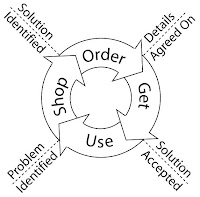
The typical problem solving cycle of any customer can be broken down into four stages, each with a trigger that starts it off. Identifying a problem triggers the customer to start looking or shopping for solutions. Identifying a viable solution triggers the customer to sort out the details and place an order. Reaching an agreement on options and payment details triggers the customer to let someone start working on delivering the solution. Accepting the final solution triggers the customer to use the solution.
Organizing Around the Customer’s Process
To keep everyone happy, you want the customer to progress through these stages as quickly and smoothly as possible. As a result most businesses are set up with four main teams, each one specializing in helping the customer through one of the primary stages of solving his or her problem.
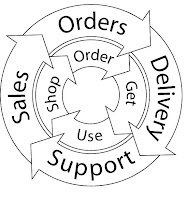
The sales team is there to help the customer understand the available solutions, the solutions your company offers, and the benefits of each solution.
The orders team is there to help the customer choose the right details and options, and agree on payment and delivery methods. The orders team must be able to answer detailed questions and offer intelligent advice to ensure the customer gets a good solution. The customer should not have to learn any more than they want to about the details of your company and its products and services. The orders teams is there to make sure all the necessary details are covered.
After an agreement is reached with the orders team, the delivery team takes over to build and deliver the solution to the customer. In a products business this would include a factory and commissioning team. In a services business this team would include the people who provide the actual service. The delivery team is often referred to as the fulfillment team since their role is to fill the order.
After the order has been delivered and accepted by the customer, it is important to have a support team there to ensure the customer has as pleasant experience using the solution. This includes addressing any problems that arise after the customer has taken delivery of the solution, and answering general questions to make life as easy for the customer as possible.
All four teams are there to help the customer through the process.
Ensuring the Business Side
Now let’s look at this from the businesses perspective. Remember the solution needs to be advantageous for both the customer and the business. We call this a win-win scenario, and it is crucial to building successful long term relationships.
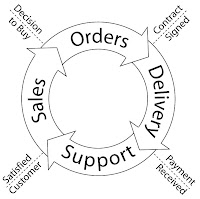
From this perspective, the sales team’s goal is to get the customer to decide that they want to buy from this business. The goal is not a purchase; the goal is a decision in their minds that they want to make a purchase. It follows that the sales team needs to understand the value of your solutions, and where they fit in the marketplace. It is not critical that they understand every detail, but they had better know where to get the answers.
The orders team’s goal is to get the purchase order. If the sales team has done its job, the customer already wants to buy. The orders team must sit down with the customer and understand the details of the problem they are trying to solve. They must then explain the available options, answer any questions, and work with the customer to find a mutually agreeable solution that helps both the customer and the business. A win-win philosophy is at the heart of all successful orders team.
From a business perspective, the delivery team’s goal is to get the customer to pay for the solution. They do this by providing a quality solution that the customer accepts. Managing delivery can be very complex, but it is critical that this complexity is not transferred onto the customer. The customer wants a quality product or service, delivered on time, and on budget. How the details are handled is not their problem. They are not that interested in how you do it. They are interested in the end result. The delivery team must deliver the end result.
So once a business has been paid for delivering a solution why continue to serve the customer? The support team’s goal is to deliver a happy customer back to the sales team so their job will be easier the next time around. This function is often under-rated by people who do not understand how much easier (and less costly) it is to sell to a customer something a second time, compared to getting a new customer. Post-delivery customer support is crucial to all successful long-term businesses. When a happy customer goes looking to solve his or her next problem, they will come to you first. An unhappy customer will go to everyone else first. The support team is there to ensure the next sale.
Summary
Healthy businesses are organized around the way customers pursue solutions to their problems.
The sales team helps the customer understand the available solutions and their benefits. The sales team helps the business get the customer to decide they want to buy.
The orders team helps the customer understand the details and place an order. The orders team helps the business understand the customer’s details and get the contract signed.
The delivery, or fulfillment team helps the customer by providing the agreed upon solution. The delivery team helps the business get the customer to pay for the solution.
The support team helps the customer by taking care of them even after they have paid their bill. The support team helps the business by delivering happy, ready to buy customers to the sales team.
Each team needs to have a strong relationship with the teams that precede and follow them in the business cycle in order to serve the customer well. Each team needs to look for the win-win balance of helping the customer and helping the business because helping the customer the right way is the same as helping the business.



